

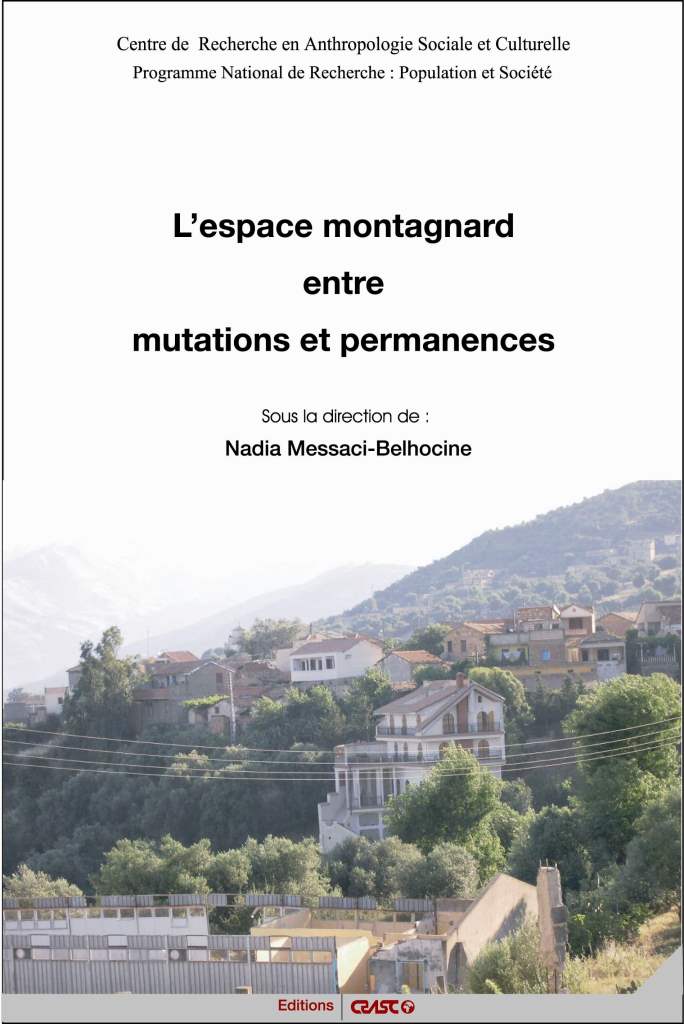
The mountainous space between change and continuity
contributors
Coordinateur :
Nadia MESSACI
abstract
This book is the result of a research team that has worked on mountainous regions and developed a PNR around the theme “mountain space: changes and continuities.” In order to understand a relatively vast territory stretching along the 1,200 km Algerian coastline, the team selected four cultural areas considered representative of the Algerian mountains and meaningful in terms of both present and future: the Aurès, the eastern Tell, and the Kabylies of Djurdjura and Ath Waghlis (Soummam). These four geographical areas, which at first glance appear highly different—a relatively arid zone (Aurès), a sparsely populated slope (eastern Tell), and a densely populated area (Kabylia)—all belong to the lower and middle mountain ranges. Their respective spatial occupations are striking in their differences, yet all have managed to combine local potentialities with the numerous constraints of the physical environment, which humans have variously exploited to turn into a living space.
The four areas are caught in the whirlwind of emigration, although there has been a declining trend in departures, particularly observed over the last decade in Kabylia. The mountain space appears to present levels of difficulty that inhabitants have addressed in different ways to ensure their survival; it still today represents a living environment for 20% of the national population (Khelil, 2000). Thus, similar difficulties have produced differentiated mechanisms of spatial production and appropriation. Here lies the first interest of this work.
The second concerns the need to produce knowledge about mountainous space, long considered the poor relation of academic research, which has been more focused on urban issues. More worryingly, the mountain has been neglected in a way that is neither specific to Algeria nor a contemporary phenomenon in human history. Indeed, researchers only turned to it relatively late. As a field of scientific inquiry, the mountain was first explored during the Renaissance. Long associated with a cultural void, poverty, and isolation, functioning as a quasi-autarkic system, mountain space has been burdened with stereotypes that have kept it apart from major civilizational currents. This “primitivization” of the mountain (Albera-Corti, 2000) draws on the idea of population concentration outside mountainous areas, seen as a response to an imbalance between population and local resources. Migration movements characteristic of Mediterranean mountain regions are also presented as objective evidence of mountain poverty. Theoretical constructions have thus been developed around the idea of a space that “exports its human capital” toward plains and cities, where it contributes to new dynamics. The mountain is thus described as “a factory of men for others,” in Braudel’s (1994) well-known expression.
And yet, facts remain stubborn. The Mediterranean mountain is characterized by a certain prosperity due to the diversity of its resources: arboriculture, cereal farming, livestock breeding, subsistence agriculture, craft activities, and a relative concentration of knowledge institutions (Jbala, Kabylia, Alps, Pyrenees). In the seventeenth century, urban scholars traveled to Kabylia to complete their education (Addi, 1994). Even today, despite the significant loss of human resources, the mountain remains a living environment. It even contains population clusters with densities sometimes comparable to urban areas. In the Ath Waghlis of Kabylia, the average density exceeds 800 inhabitants/km² (Messaci, 2003). In the eastern Tell, it is higher than that of the Annaba plain (Boukerzaza, Boughaba, 2001).
The mobility of mountain populations, according to recent studies (Albera-Corti, 2000), reflects their “capacity to access employment segments at both national and international levels.” The range of activities performed by these migrants is broad enough to challenge the long-held assumption that they are an unskilled labor force. Mountain inhabitants occupy a wide variety of jobs, often unknown in their home environments (Pyrenees, Kabylia, Aurès): traders, civil servants, hammam managers, teachers, etc. (Adel, Messaci, 2002). This diversification of employment supports Albera-Corti’s notion of “export of skills” (p. 364), a competence likely fostered by relatively developed educational structures. Among the Ath Waghlis, the importance of pre-colonial schooling networks, reinforced by French colonial education, has significantly contributed to this exportable skill set.
The mountain can thus be considered a cognitive space, and it is no coincidence that French colonization implemented a particularly targeted schooling policy in Kabylia. The placement of republican schools on the same sites as Qur’anic schools was also part of a strategy aimed at undermining pre-colonial education. The introduction of external elements into spaces considered closed and autarkic raises scientific interest and suggests a process of osmosis that deserves study.
The mountain is also confined to the stereotype of a space of itinerant trade (colportage). While colportage remains a widespread activity in mountainous regions (Alps, Pyrenees, Kabylia), it demonstrates the capacity for commercial penetration and expansion, which modern communication technologies and their prospects in the eighteenth and twentieth centuries have made transnational. L. Fontaine’s work (1993) highlights the essential role of colporteurs, long regarded as marginal actors, but in reality crucial to pre-modern societies seeking both openness and social stability. Colportage, as a form adapted to merchant migration, reflects the mobility of mountain societies and challenges stereotypes of immobility linked to autarky. This culture of mobility does not imply regression; rather, it reflects adaptation to a difficult environment.
This negative perception of mountain space may also explain its marginalization in territorial planning policies. Early development policies, focused on industry and agriculture, led to monolithic planning approaches. It was only with the law of 27/01/1987, and later that of 12/12/2001, that physical and regional specificities were formally acknowledged. For the first time, the mountain was included in an integrated policy framework. However, in the absence of appropriate tools, its implementation quickly revealed limitations. Urban planning instruments were applied to mountain areas, proving inadequate.
For example, the housing occupancy rate (TOL), widely used in PDAU studies, is not suitable for the kabyle house (axxam), which is a multifunctional space. How, then, can TOL be calculated, and to what extent do interpretations reflect the social reality of spatial appropriation in Kabyle housing?
Zoning techniques, widely used in urban planning instruments (PDAU, POS), are also ineffective in mountain areas, where spatial identity is strongly rooted in community structures. Spatial appropriation is first and foremost organized around the village and kinship group as primary reference points. Thus, locating housing zones that mix families from different villages contradicts local spatial logic.
Land tenure (melk) also complicates planning interventions. Despite legal provisions allowing expropriation for public utility, property rights remain a major obstacle that planners must negotiate.
The mountain is certainly a “conservatory” (Brunet, 1993), but above all it is a constantly evolving space that transforms inherited values while ensuring their continuity.
The study of continuities and changes in mountain areas has enabled the production of more up-to-date knowledge based on fieldwork. As an object of study, the mountain requires a multidisciplinary approach to enrich scientific analysis. The PNR team benefits from this perspective, bringing together geographers, sociologists, an anthropologist, and an architect. The viewpoint on this space is therefore plural. The structure of this book reflects this. The individual presentation of each area corresponds to a monographic approach, although comparison and synthesis are not excluded. The resulting work resembles a patchwork, whose analytical synthesis forms the backbone of the general conclusion.