

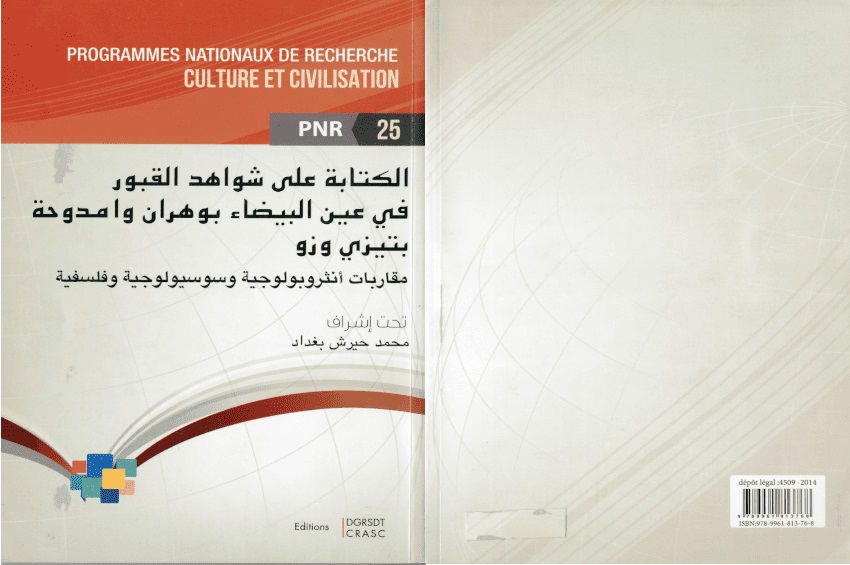
Epitaphs in the Cemeteries of Aïn el-Beyda (Oran) and Amdouha (Tizi Ouzou).
An Anthropological, Sociological and Philosophical Approach
contributors
Sous Direction :
Mohamed HIRRECHE BAGHDAD
abstract
Since 2009, we have been working on the subject of inscriptions on tombstones in Algeria, within the framework of an institutional research project at the National Center for Research in Social and Cultural Anthropology (CRASC), as well as a national research project (2011–2013). Our methodology relied on continuous field observation supported by photography, covering numerous local spaces (the city of Oran and surrounding villages and municipalities), national sites (Béjaïa, Tizi Ouzou, Aïn Témouchent, Tlemcen, Sidi Bel Abbès, Adrar, Tindouf, Béni Abbès), Arab cemeteries (Sahab in Amman, Riyadh in Nouakchott, Kırka Ahmed in Istanbul), and Islamic cemeteries abroad (Bobigny, Paris). This breadth of observation allowed for comparative analysis. We also examined Christian cemeteries in Algeria and abroad (Leipzig, Germany).
Fieldwork included collecting testimonies and conducting interviews with social actors (cemetery workers, families of the deceased, artisans). We reviewed literature on thanatology, notably Louis-Vincent Thomas (Representations of Death Today in the West) and Philippe Ariès (The Hour of Our Death), as well as texts from the Revue Africaine to identify prevailing discourses in the 18th and 19th centuries. We consulted references on Arabic and Turkish inscriptions in Algeria, including Gustave Marçais (Constantine) and Gabriel Colin (Algiers).
Funerary inscriptions have primarily been studied by archaeologists, with whom we established partnerships, particularly with researchers at the Institute of Archaeology in Algiers—Abdelhak Mazouz (Islamic period) and Slim Idris (Roman period). Through this collaboration, we examined the oldest funerary text discovered in the region of Tahouda (Biskra), dating to the 7th century CE, commemorating Abd al-Rahman ibn Haywa, one of the tabi‘un who was martyred in the area……..